
 Spanish
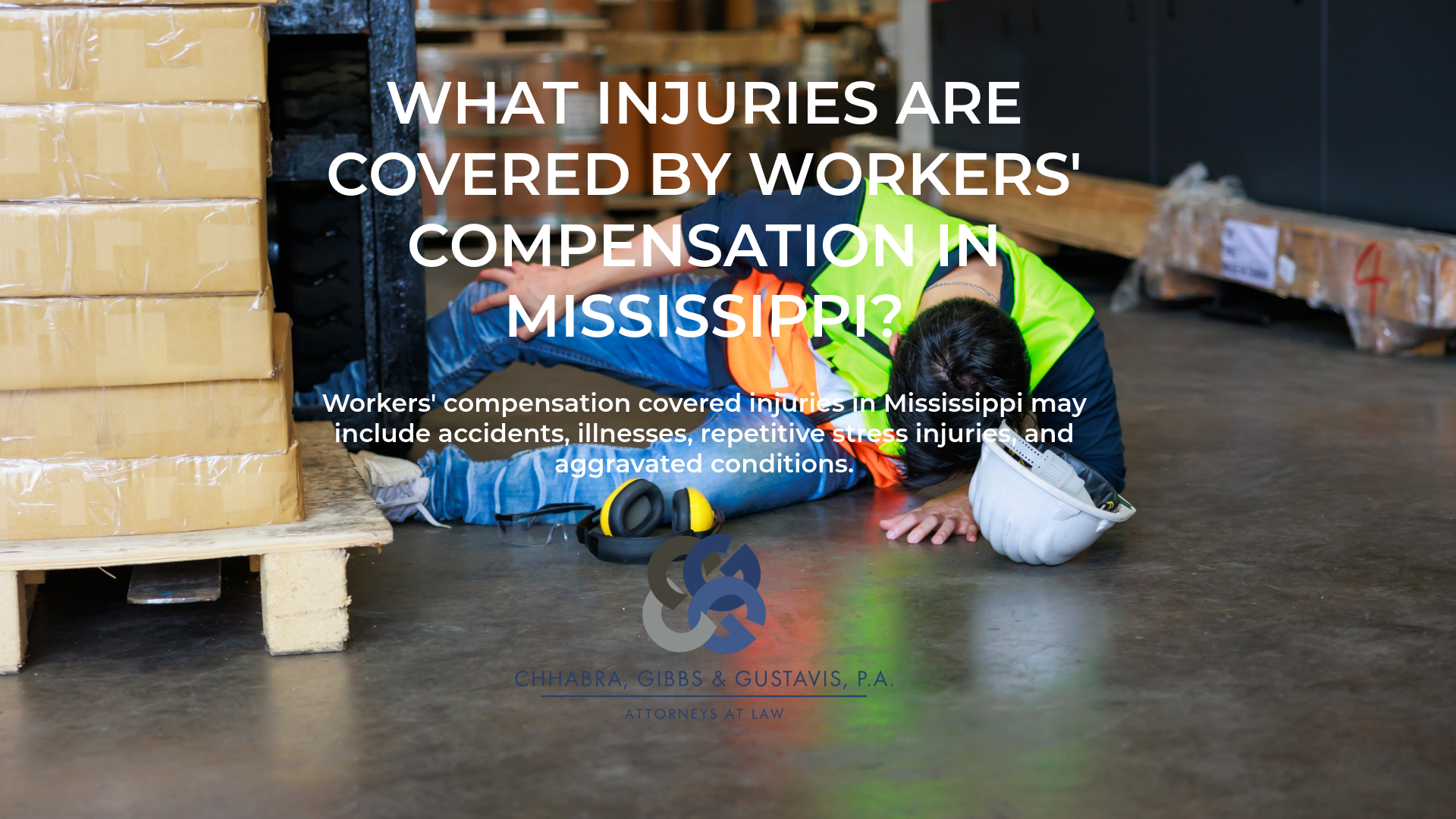
Injured on the job and you want to know if workers’ comp will cover your claim?
Speak with an attorney from Chhabra, Gibbs & Gustavis, P.A. today so you can get informed on what to do next.
📞 Call Now for a Free Consultation: (601) 948-8005If you’ve been hurt on the job in Mississippi, one of the first questions you’re likely asking is whether your injury qualifies for workers’ compensation benefits. It’s a reasonable concern—medical bills don’t wait, and if you’re unable to work, the financial pressure can mount quickly. Understanding workers’ compensation covered injuries under Mississippi law recognizes can help you determine whether you may be entitled to benefits.
Mississippi’s workers’ compensation system exists to provide injured employees with medical care and wage replacement benefits after a work-related injury or illness. However, not every injury automatically qualifies for coverage. Understanding what types of injuries are covered—and what circumstances can complicate a claim—can make a significant difference in protecting your rights and securing the benefits you deserve.
The Basic Standard: Arising Out of and in the Course of Employment
Mississippi law requires that a covered injury must “arise out of and in the course of employment.” This two-part standard is the foundation of nearly every workers’ compensation claim in the state.
“Arising out of employment” means there must be a connection between your job duties and the injury. “In the course of employment” generally means the injury occurred while you were performing work-related duties or engaging in activities reasonably connected to your job.
When these requirements are met, the injury will often fall within the category of workers’ compensation covered injuries. Because workers’ compensation is a no-fault system, employees generally do not need to prove their employer did anything wrong. Instead, they must show that the injury is work-related.
Types of Injuries Covered by Mississippi Workers’ Compensation
Traumatic or Sudden Injuries
The most common category of workers’ compensation covered injuries in Mississippi that workers experience involves sudden accidents that occur during the course of employment.
Examples include:
- Falls from ladders, scaffolding, or slippery surfaces
- Being struck by falling objects
- Broken bones and fractures
- Crush injuries involving machinery or equipment
- Burns from chemicals, fire, or electrical accidents
- Eye injuries caused by debris or hazardous substances
- Back and neck injuries from lifting, twisting, or sudden impacts
- Concussions and traumatic brain injuries
Whether you work in construction, manufacturing, healthcare, transportation, or an office setting, sudden workplace accidents can happen anywhere. If the injury occurred while performing your job duties, it will likely qualify for workers’ compensation benefits.
Occupational Diseases and Work-Related Illnesses
Not all workplace injuries happen in a single moment. Some conditions develop gradually due to repeated exposure to hazards in the workplace.
Occupational illnesses are another category of injuries covered by workers’ compensation in Mississippi and may include:
- Respiratory illnesses caused by dust, mold, asbestos, or chemical exposure
- Occupational hearing loss from prolonged exposure to loud noise
- Skin disorders caused by hazardous substances
- Chemical poisoning
- Mesothelioma and other asbestos-related diseases
- Chronic lung conditions related to workplace contaminants
To qualify, the illness must be directly connected to the employee’s work environment and not simply a condition commonly found in the general public.
Repetitive Motion and Cumulative Trauma Injuries
Many workers develop injuries over months or years rather than from a single accident. Mississippi workers’ compensation law recognizes many repetitive stress and cumulative trauma conditions.
Common examples include:
- Carpal tunnel syndrome
- Tendinitis
- Rotator cuff injuries
- Chronic back pain from repetitive lifting
- Knee injuries from constant kneeling or squatting
- Joint deterioration caused by repetitive physical labor
These injuries are often disputed because employers and insurance carriers may argue that aging or non-work activities caused the condition. However, many repetitive stress conditions qualify as workers’ compensation covered injuries therefor employees can pursue benefits for when medical evidence supports the claim.
Aggravation of Pre-Existing Conditions
Many workers assume they cannot recover benefits if they had a prior injury or medical condition. Fortunately, that is not always true.
Mississippi workers’ compensation law may provide benefits when workplace duties aggravate, accelerate, or worsen a pre-existing condition.
For example:
- A worker with degenerative disc disease suffers a lifting injury that requires surgery.
- An employee with a prior knee condition experiences a workplace fall that significantly worsens the injury.
- A worker with a previous shoulder injury suffers additional damage from repetitive overhead work.
Aggravated conditions may still qualify as workers’ compensation covered injuries in Mississippi, even when the worker was not in perfect health before the accident occurred.
Mental Health and Psychological Injuries
Mental health conditions can sometimes qualify for workers’ compensation benefits, although these claims are often more challenging.
Examples may include:
- Post-traumatic stress disorder (PTSD)
- Depression following a severe workplace injury
- Anxiety resulting from a traumatic workplace accident
In many situations, psychological injuries are more likely to be covered when they are connected to a compensable physical injury. Purely mental or emotional claims without a related physical injury may face greater scrutiny under Mississippi law.
Injuries That May Not Be Covered
While the workers’ compensation system provides broad protection, there are limits.
Some injuries that may not qualify include:
- Injuries sustained during a normal commute to or from work
- Injuries caused by intoxication or illegal drug use
- Intentional self-inflicted injuries
- Injuries resulting from horseplay unrelated to work duties
- Certain injuries involving independent contractors
However, exceptions often exist. If your claim has been denied because your employer believes your injury falls into one of these categories, it may still be worth consulting an attorney.
What Benefits Are Available for Covered Injuries?
When an employee suffers one of the recognized injuries covered by workers’ compensation law protects, several forms of benefits may be available.
Medical Benefits
Workers’ compensation generally covers reasonable and necessary medical treatment, including:
- Doctor visits
- Hospitalization
- Surgery
- Physical therapy
- Diagnostic testing
- Prescription medications
Temporary Total Disability (TTD)
If your injury prevents you from working while you recover, you may receive temporary wage replacement benefits.
Temporary Partial Disability (TPD)
If you return to work in a limited capacity and earn less than before your injury, partial disability benefits may be available.
Permanent Partial Disability (PPD)
Workers who suffer permanent impairments may be entitled to compensation based on the affected body part and degree of disability.
Permanent Total Disability (PTD)
Severe injuries that prevent a worker from returning to gainful employment may qualify for long-term disability benefits.
Death Benefits
When a worker dies from a work-related injury or illness, eligible dependents may receive death benefits and funeral expense coverage.
What Should You Do After a Workplace Injury?
The actions you take after an injury can significantly impact your claim.
Report the Injury Immediately
Mississippi generally requires employees to report workplace injuries within 30 days. Reporting the injury promptly creates documentation and helps avoid disputes.
Seek Medical Treatment
Obtaining medical care quickly protects both your health and your claim. Medical records often become some of the most important evidence in a workers’ compensation case.
Document Everything
Keep records of:
- Medical appointments
- Treatment plans
- Work restrictions
- Communications with your employer
- Lost wages and missed work
Follow Medical Advice
Missing appointments or ignoring treatment recommendations can give insurance companies reasons to question your claim.
Know the Filing Deadlines
In most cases, Mississippi workers have two years from the date of injury or from when an occupational illness was discovered to file a claim.
Why Workers’ Compensation Claims Get Denied
Even when an injury appears legitimate, claims are sometimes denied.
Common reasons include:
- Failure to report the injury on time
- Lack of medical evidence
- Disputes about whether the injury occurred at work
- Allegations that the condition was pre-existing
- Questions regarding employee versus independent contractor status
A denial does not necessarily mean you are ineligible for benefits. Many denied claims are later approved after additional evidence is presented.
How Chhabra, Gibbs & Gustavis Can Help
Navigating the workers’ compensation system can be overwhelming, especially when you’re trying to recover from an injury while dealing with insurance companies and legal deadlines.
The attorneys at Chhabra, Gibbs & Gustavis, P.A. have experience helping injured workers throughout Mississippi understand their rights and pursue the benefits they deserve. Whether you’re dealing with a denied claim, a disputed injury, or questions about your eligibility, the firm can help evaluate your situation and explain your options.
With offices serving clients throughout Mississippi, including Jackson and Gulfport, CGG Law is committed to helping injured workers seek the compensation available under the law.
Call 601-948-8005 or visit cglawms.com to learn more.
Jackson Office
Address
120 N Congress St Suite 200, Jackson, MS 39201
Google Map
Gulfport Office
Address
2202 25th Ave Suite C2, Gulfport, Mississippi 39501
Google Map
Frequently Asked Questions
Workers’ compensation generally covers injuries and illnesses that arise out of and in the course of employment, including accidents, occupational diseases, repetitive stress injuries, and aggravations of pre-existing conditions.
Yes. Back injuries caused by lifting, falls, repetitive motions, or workplace accidents are among the most common workers’ compensation claims in Mississippi.
Yes. Conditions such as carpal tunnel syndrome, tendinitis, rotator cuff injuries, and chronic back problems may qualify if they are connected to job duties.
Yes. Occupational diseases and illnesses caused by workplace exposure to hazardous substances, chemicals, noise, or asbestos may be covered.
A pre-existing condition may be covered if a workplace accident or job duties aggravated, accelerated, or worsened the condition.
In some situations. Psychological conditions such as PTSD, depression, or anxiety may qualify when they are connected to a compensable workplace injury or traumatic event.
Injuries sustained during a normal commute, injuries caused by intoxication, intentional self-harm, and certain horseplay-related injuries may not be covered.
Benefits may include medical treatment, temporary disability payments, permanent disability benefits, vocational rehabilitation, and death benefits for eligible dependents.
Generally, employees should report workplace injuries within 30 days to protect their right to benefits.
You should gather evidence, review the reason for the denial, and consider speaking with a workers’ compensation attorney about your options for appealing the decision.
Protect Your Rights After a Workplace Injury
A workplace injury can affect every aspect of your life. Understanding which workers’ compensation covered injuries under Mississippi law recognizes is an important first step toward protecting your health, finances, and future.
Whether your injury occurred suddenly in an accident, developed over years of repetitive work, or resulted from exposure to dangerous workplace conditions, you may have rights under Mississippi workers’ compensation law. The sooner you understand those rights and take action, the better positioned you’ll be to secure the benefits you need during your recovery.
Share: